
Table of Contents
- What the Hamsa Hand Symbol Means in Jewelry
- Hamsa Hand Facing Up vs Down Meaning
- Why Tarnish Free Evil Eye Jewelry Matters for Daily Wear
- How to Style Hamsa Necklaces for Every Aesthetic
- Wearing Hamsa Jewelry as a Fashion Statement
- Caring for Your Hamsa Jewelry: Maintenance Tips
- Conclusion
- Frequently Asked Questions
Last Updated: September 11, 2026
What the Hamsa Hand Symbol Means in Jewelry
The hamsa hand is a palm-shaped amulet used across Mediterranean and Middle Eastern cultures to ward off negative energy and invite protection, good fortune, and blessings. In jewelry, the hamsa hand jewelry meaning goes beyond decoration: it carries centuries of spiritual symbolism into a wearable form. This guide from Gemma Azzurro covers what the symbol represents, how to wear it, and how to choose pieces that last.

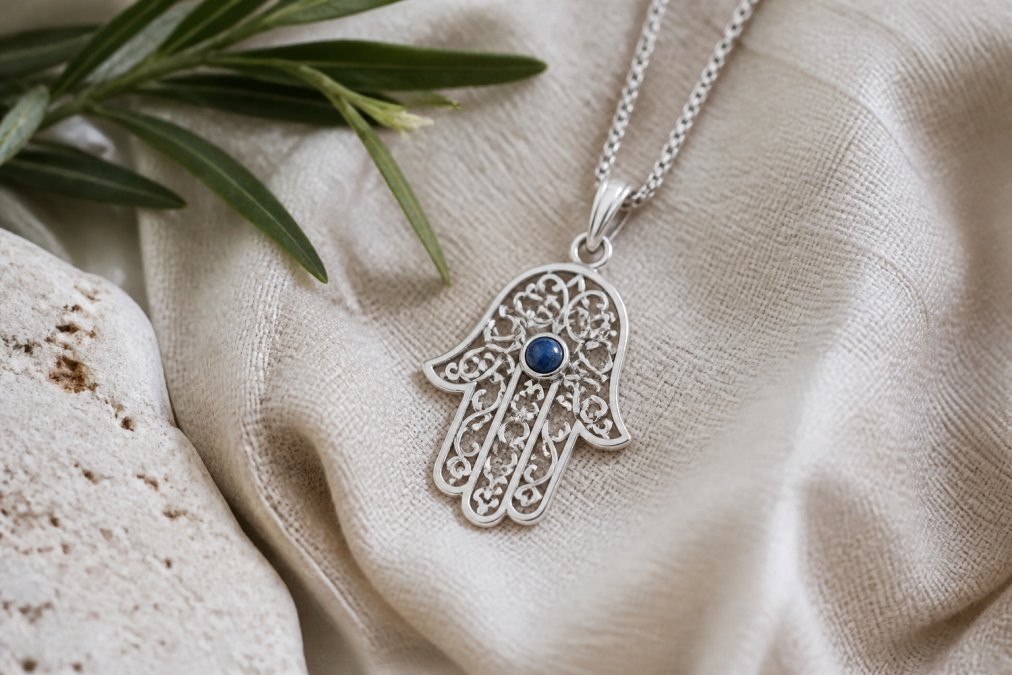
A hamsa hand is a stylized open palm, typically with five fingers and often an eye set in the center of the palm. The eye reinforces the protective purpose, echoing the evil eye motif that appears throughout Mediterranean folk tradition.
Ancient Origins and Cultural Significance
Its roots stretch back thousands of years across multiple faiths and regions. The symbol appears in Islamic tradition as the Hand of Fatima, in Jewish culture as the Hand of Miriam, and in Christian communities as the Hand of Mary. Each tradition frames the palm as a sacred protective sign, though the core idea stays consistent: an open hand that turns away harm.
Archaeologists have found hamsa-like motifs on amulets, architectural details, and textiles across North Africa and the eastern Mediterranean. The symbol traveled with merchants and migrants, which explains why it shows up in so many cultures under different names. Smithsonian overview of amulets and protective symbols
The hamsa functioned as everyday folk protection, worn by people of all backgrounds. That everyday quality is exactly why it translates so well into modern jewelry.
Hamsa vs. Evil Eye: Two Protective Symbols Explained
The evil eye and the hamsa are related but distinct. The evil eye is the harmful gaze itself, a curse believed to cause misfortune, illness, or bad luck. The hamsa is the defense against it, a protective hand that deflects that gaze.
Many pieces combine both: a hamsa with an eye in the palm, or an evil eye bead paired with a hamsa charm. If you want one symbol that carries both the threat and the protection, a combined design works. If you prefer a cleaner look, a plain hamsa silhouette is quieter and easier to layer.
Hamsa Hand Facing Up vs Down Meaning
The direction of the fingers changes the emphasis, not the core protection. An upward-facing hamsa, with fingers pointing toward the sky, is generally associated with warding off the evil eye and inviting blessings and good fortune. A downward-facing hamsa, fingers pointing down, is often linked to drawing abundance and prosperity toward the wearer.
Neither is "correct." The choice is personal and largely cultural. Here's the practical breakdown:
| Orientation | Common Meaning | Best For |
|---|---|---|
| Fingers up | Ward off negative energy, invite blessings | Traditional protective wear, everyday pieces |
| Fingers down | Draw in prosperity, welcome good fortune | Statement pieces, gift-giving |
A common mistake is overthinking this. If you love how a piece looks, the orientation is a secondary detail.
Why Tarnish Free Evil Eye Jewelry Matters for Daily Wear
Tarnish-free evil eye jewelry is built from metals that resist discoloration, so the piece keeps its finish through showers, workouts, and daily exposure to perfume and skin oils. That resistance is what separates jewelry you wear once from jewelry you wear every day.
Sterling silver and gold plating are the two most common approaches. Sterling silver, an alloy of silver and other metals, holds up well and develops a natural patina over time (geology.com). Gold plating over a sterling silver base gives you the warm gold look with a durable core underneath.

Sterling Silver and Gold Plating: What to Look For
Check the base metal first. A sterling silver base with 18k gold plating will outlast a brass or base-metal piece with a thin gold wash, because the underlying metal is stronger and less prone to reacting with your skin (nickelinstitute.org).
- Look for a 925 stamp on sterling silver pieces
- Check the plating thickness and karat (18k gold plating is a common quality marker)
- Avoid unknown base metals if you have sensitive skin
- Confirm the piece is designed for daily wear, not just display
At Gemma Azzurro, our hamsa and evil eye pieces are made from sterling silver and 18k gold plating, crafted for long-lasting durability and everyday wear.
How to Style Hamsa Necklaces for Every Aesthetic
Styling a hamsa necklace comes down to three variables: scale, metal tone, and how you layer it. Get those right and the same pendant can read minimalist on Monday and bohemian on Saturday.
The Three Variables That Change Everything
- Scale: A pendant under about 0.5 inches reads as dainty and disappears into a layered stack. A pendant over about 1 inch becomes the focal point and should be worn alone or as the anchor of a stack.
- Metal tone: Match your hamsa to the metal you already wear most. Mixing a warm gold hamsa into an all-silver wardrobe is the single most common styling mistake, it reads as an afterthought rather than a choice.
- Chain weight: A fine 1mm chain keeps a hamsa quiet; a 2mm+ chain or a beaded/box chain makes it deliberate. The pendant should never outweigh the chain visually.
Minimalist
One dainty hamsa on a fine chain, worn alone or with a single plain chain of a different length. Keep the pendant under 0.5 inches and the chain under 1mm. Pair with a crewneck tee, a button-down, or a plain knit, the point is that the hamsa is the only decorative element. Skip stones; a plain metal silhouette reads cleanest here.
Bohemian
Layer the hamsa with beads, coins, or a longer pendant, and lean into mixed textures. A hamsa on a beaded chain, stacked with a coin necklace and a longer pendant, sits well over a flowy dress, a crochet top, or an open linen shirt. This is the aesthetic where a slightly larger hamsa (0.75-1 inch) earns its place, because it needs to hold its own against the other elements.
Coastal
A hamsa with a blue or green stone, turquoise, aquamarine, or a green agate, paired with light fabrics: white linen, chambray, seersucker. Keep the metal tone consistent (all gold or all silver) and keep the chain simple so the stone does the talking. This is the aesthetic where a hamsa with an eye in the palm works especially well, because the blue stone and the eye motif reinforce each other.
Statement
A larger hamsa (1 inch and up) worn as the single focal piece, on a heavier chain, over a solid-color top or a structured blazer. No layering, the piece is the outfit's anchor. This is also the aesthetic where a downward-facing hamsa (fingers pointing down) reads most intentionally, because the orientation is visible at a glance rather than lost in a stack.
Layering Hamsa Necklaces with Other Chains
The rule for layering is contrast in length and weight. Keep at least an inch or two between chains so they don't tangle, and vary the thickness so each piece reads clearly.
A practical layering formula:
- Start with a short chain (14-16 inches) as the base
- Add a mid-length hamsa pendant (16-18 inches) as the focal point
- Finish with a longer chain (20-24 inches) for balance
- Keep one metal tone dominant to avoid visual clutter
Our Sterling silver gold plated dainty green hamsa necklace is sized for exactly this kind of layering, at 15-17 inches and made from sterling silver with 18k gold plating.
Wearing Hamsa Jewelry as a Fashion Statement
You don't need to be spiritual to wear a hamsa. Plenty of people wear it purely for how it looks, and that's a legitimate way to wear it.
The symbol works as a fashion statement because the silhouette is clean and recognizable. It reads as intentional without being loud, which is why designers keep returning to it. Wearing hamsa jewelry for fashion and wearing it for meaning aren't in conflict; the piece carries both.
If you're drawn to the design more than the symbolism, choose pieces that fit your wardrobe first. A hamsa in a metal tone you already wear will get more use than one you bought for the meaning alone.
Caring for Your Hamsa Jewelry: Maintenance Tips
Protective jewelry lasts longer with a few simple habits. The biggest enemies are moisture, chemicals, and friction, so keep those in check and your piece will hold its finish.
- Put jewelry on last: after lotion, perfume, and hair products have dried
- Take it off first: before showering, swimming, or working out
- Wipe after wear: a soft dry cloth removes oils and residue
- Store separately: a pouch or lined box prevents scratches
- Polish gently: a jewelry cloth restores shine without harsh chemicals
- Check clasps and links: small repairs early prevent lost pieces
Conclusion
Choosing hamsa jewelry that lasts comes down to base metal, plating quality, and how you care for it. Gemma Azzurro crafts Mediterranean-inspired hamsa and evil eye pieces from high-quality sterling silver and 18k gold plating, designed for long-lasting durability and everyday wear. Every order includes a 14-day money-back guarantee, free shipping on USA orders over $150, and a 10% discount when you sign up for the newsletter. Explore the collection and find a piece that carries meaning and holds up to daily life.

Frequently Asked Questions
Should a hamsa hand face up or down?
Both directions carry meaning. Facing up, the fingers point skyward to ward off negative energy and invite blessings. Facing down, the hand opens toward the wearer to draw in good fortune and protection. There is no wrong choice. Many people pick the direction that feels right for their intention, while others choose based on how the pendant sits on a chain. Gemma Azzurro offers hamsa designs in both orientations so you can wear the meaning that resonates with you.
What is the difference between the hamsa hand and the evil eye?
The hamsa is a palm-shaped amulet with five fingers, often featuring an eye in the center. The evil eye is a distinct symbol, usually a concentric blue circle, worn to deflect jealous or harmful glances. Both are protective signs, and they are frequently combined in a single piece. When the eye appears inside the hamsa palm, the jewelry carries the protective power of both symbols at once. Many people wear them together for layered meaning.
Can I wear hamsa jewelry if I am not Jewish or Muslim?
Yes. The hamsa appears across Jewish, Muslim, and Christian traditions, and it is also worn by people with no religious affiliation who simply appreciate the design. It is considered a universal symbol of protection and good fortune. Wearing it respectfully, whether for spiritual reasons or as a fashion statement, is widely accepted. If you are drawn to the craftsmanship and meaning, there is no cultural barrier to enjoying hamsa jewelry as part of your everyday style.
How do I keep hamsa jewelry from tarnishing?
Choose sterling silver or 18k gold-plated pieces over base metals. Remove jewelry before showering, swimming, or working out. Apply perfume and lotion before putting on your pieces, not after. Store each item in a dry pouch or lined box away from direct sunlight. Wipe with a soft cloth after wearing to remove oils. Gemma Azzurro's sterling silver and gold-plated hamsa designs are crafted for long-lasting durability and everyday wear with proper care, and come with a 14-day money-back guarantee.


