
Table of Contents
- Why Evil Eye Jewelry Belongs in Your Everyday Rotation
- How to Stack Evil Eye Bracelets for Visual Depth
- Wearing an Evil Eye Necklace With Other Chains
- Evil Eye Jewelry Etiquette: Rules and Traditions
- Choosing the Right Metal for Your Skin Tone
- Occasion-Based Styling: From Workdays to Weekends
- Maintenance and Energetic Cleansing for Long-Lasting Pieces
- Budget-Friendly vs. Investment Styling
- Frequently Asked Questions
Last Updated: September 15, 2026
Why Evil Eye Jewelry Belongs in Your Everyday Rotation
Evil eye jewelry is protective symbolism designed for daily wear, not special occasions. The nazar, a stylized eye in blue and white, has guarded Mediterranean households for centuries, and modern styling treats it as a wardrobe staple. This guide from Gemma Azzurro breaks down how to style evil eye jewelry so it works with your existing wardrobe.
These pieces layer well because of design: an eye motif is small, round, and self-contained, so it sits beside a watch, a signet ring, or a plain chain without fighting for attention. Many stylists treat the evil eye as the most versatile protective amulet in a jewelry box for that reason.
Most guides get this wrong: they treat the eye as a novelty charm worn alone. In practice, the pieces worn every day are stacked, layered with other chains, and rotated through workdays and weekends. We will show you how to build those combinations, and how to keep plated and sterling pieces looking new.
How to Stack Evil Eye Bracelets for Visual Depth
Stacking evil eye bracelets means combining three to five bracelets of different weights, textures, and finishes on one wrist so the eye charm reads as a focal point. The goal is visual depth: a mix of beaded, metal, and delicate chain styles that catch light at different angles.
Start with an anchor: a beaded eye bracelet or slightly heavier chain sets the baseline, then build outward with thinner pieces. Stacking five bracelets of identical width flattens the look into a single band.

Mixing Beaded and Metal Bracelets
Alternate textures rather than grouping them: one beaded bracelet, one smooth metal cuff, one fine chain. The contrast between matte stone and polished metal creates depth; three beaded bracelets in a row look repetitive.
Creating a Focal Point With One Statement Piece
Every stack needs one piece that draws the eye first, a charm bracelet with a larger pendant, or one with a colored gemstone. Keep the other two to four bracelets quiet and let the statement piece carry the visual weight.
Wearing an Evil Eye Necklace With Other Chains
Wearing an evil eye necklace with other chains is about length separation, not quantity. Two or three chains at clearly different lengths look balanced; two at nearly the same length tangle and look accidental. The eye pendant should sit at the longest or shortest point of the stack, never buried in the middle.
Length Pairing for a Balanced Look
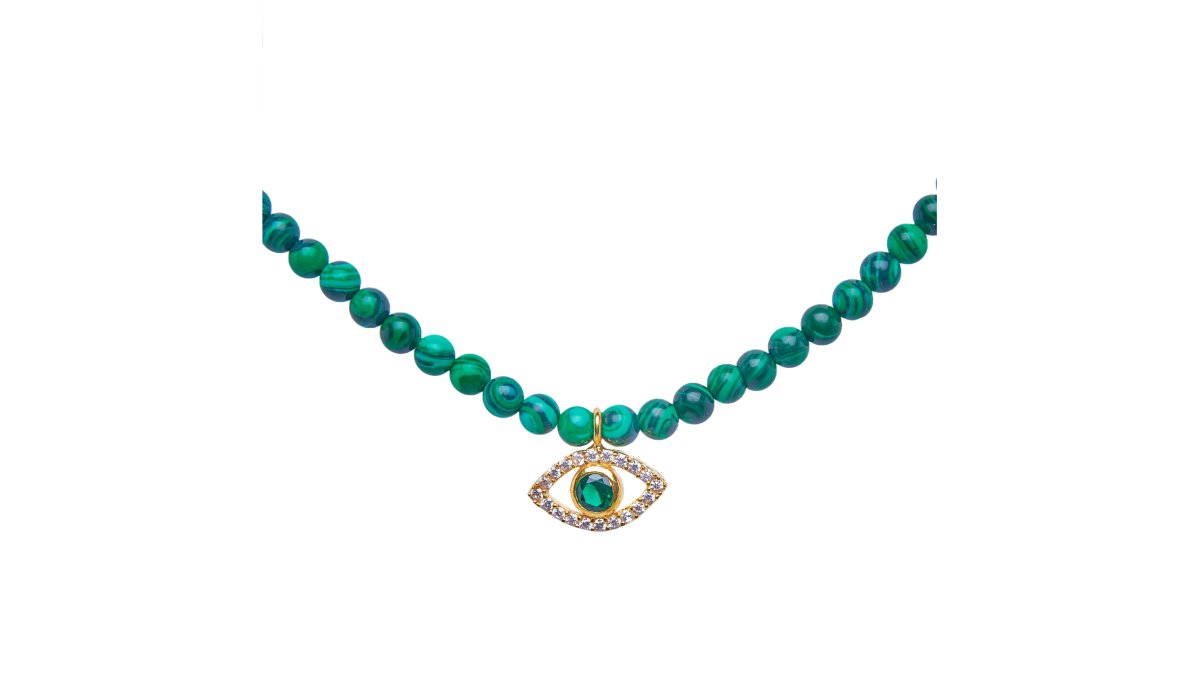
A 14.5-16.5 inch necklace, like the Malachite beaded eye necklace, sits at the collarbone and pairs with a choker above or a longer chain below. Keep at least a two-inch gap between layers so the chains hang independently.
Mixing Gold and Silver Finishes
Mixed metals are a deliberate choice, not a mistake. Anchor the mix with one dominant finish and use the second as an accent: a gold-plated chain with a single silver pendant, for example. The silver gold plated herringbone green eye choker does this in one piece, combining a sterling silver base with 18k gold plating and green cz stones.


| Layer Position | Length Range | Best Pairing | Effect |
|---|---|---|---|
| Choker | 13-15 inches | Worn alone or with one longer chain | Sits high, frames the neck |
| Collarbone | 14.5-16.5 inches | Pairs with a choker above | Balanced, everyday look |
| Mid-length | 18-20 inches | Pairs with a short chain above | Layered, casual feel |
Evil Eye Jewelry Etiquette: Rules and Traditions
Evil eye etiquette is less about hard rules than widely shared customs that vary by household, region, and generation. Knowing where they come from lets you decide which to keep and which to ignore, rather than guessing whether you are wearing the symbol "wrong."
The customs that come up most often:
- The eye faces outward. The most common tradition holds that the eye should point away from the wearer, toward the world, so it can deflect envy before it reaches you. On a necklace, that means the pendant faces forward. On a bracelet, the charm sits on the outer wrist. On a ring, the eye faces away from the palm.
- A gifted piece carries more weight. Many traditions hold that a nazar given as a gift is more potent than one bought for yourself. This is a custom, not a requirement, plenty of wearers buy their own and treat it the same.
- A cracked or broken piece did its job. When an evil eye cracks, the traditional reading is that it absorbed a hit meant for you. Some retire the piece; others replace it and keep the broken one as a keepsake.
- Don't store a gifted piece in a drawer. The custom is to wear it, not shelve it. If it doesn't suit your style, pass it on to someone who will wear it.
What most guides flatten is that placement traditions differ by culture. In some Mediterranean and Middle Eastern households, the eye faces the wearer to reflect negativity back. In others, it faces outward to deflect. Neither is more correct, and the choice often comes down to what you were raised with.
Placement and Positioning on the Body
Where you wear the eye matters as much as which piece you pick:
- Neck: the pendant sits at the collarbone or sternum, facing forward, the most visible placement and the one most associated with everyday wear.
- Wrist: the charm sits on the outer wrist so it faces outward when your arms are at your sides. A bracelet worn on the dominant hand gets more movement and more visibility.
- Ear: huggie hoops and studs keep the eye close to the face, which reads as a subtle, personal placement rather than a statement.
- Finger: a ring with the eye facing away from the palm keeps the symbol oriented outward when your hand is relaxed.
If you wear more than one evil eye piece at once, keep the largest eye as the focal point and let the smaller ones sit as accents, the same logic that governs stacking, applied across the outfit.
Choosing the Right Metal for Your Skin Tone
The right metal for your skin tone depends on your undertone, not your surface color. Cool undertones (pink or blue veins at the wrist) suit sterling silver and white gold (the American Academy of Dermatology). Warm undertones (greenish veins, golden cast) suit yellow gold and gold-plated pieces. Neutral undertones can wear either.
Most styling guides skip this, and it matters more than the charm itself. A gold-plated eye pendant that flatters your skin gets worn ten times more often than a silver one that does not.
If you sit between the two, mixed-metal pieces solve the problem outright.
Occasion-Based Styling: From Workdays to Weekends
Maintenance and Energetic Cleansing for Long-Lasting Pieces
Physical Care: What Actually Causes Damage
Gold-plated and sterling silver jewelry fail for predictable reasons:
Energetic Cleansing: A Practical Routine
A few common approaches:
Budget-Friendly vs. Investment Styling
Frequently Asked Questions
Can you wear evil eye jewelry every day?
Yes, you can wear evil eye jewelry daily. Choose pieces made from durable materials like sterling silver or 18k gold-plated silver, which resist tarnishing and hold up to repeated wear. Remove jewelry before showering, swimming, or applying perfume to extend its life. Many people wear a single evil eye necklace or a pair of huggie hoops as a daily staple, then add bracelets or rings for variety. The key is selecting well-made pieces designed for everyday use, not just special occasions.
How do you style evil eye bracelets with other jewelry?
Start with one focal evil eye bracelet, then layer thinner chains or beaded bracelets alongside it. Mix textures like smooth metal with faceted gemstones to create visual depth. Keep the stack to three to five bracelets for balance. If your evil eye bracelet is gold, pair it with other gold or warm-toned pieces; if silver, stick with cool tones or mix metals intentionally. A malachite beaded eye necklace can echo the green tones in a bracelet stack for a coordinated look.
Should evil eye jewelry be worn on a specific side of the body?
In many Mediterranean traditions, the evil eye is worn on the left side of the body to absorb negative energy directed at the wearer. However, modern styling often prioritizes comfort and aesthetics over strict rules. If you are wearing multiple pieces, you can place a focal evil eye necklace on the left and balance with bracelets on either wrist. There is no universal rule, so wear it where it feels right for you.
How to mix gold and silver evil eye pieces?
Mix gold and silver evil eye pieces by choosing a dominant metal and using the other as an accent. For example, wear a gold-plated herringbone choker with green eye as your main piece, then add a silver bracelet or small silver hoops. Keep the ratio around 70/30 so the look feels intentional. Textures like hammered silver or twisted gold chains help bridge the two tones. Gemma Azzurro offers pieces in both finishes, making it easy to build a mixed-metal set that still feels cohesive.


