
Table of Contents
- Why Gold Plated Jewelry Deserves a Second Look
- Gold Plated vs. Gold Vermeil vs. Gold Filled: What the Labels Mean
- How Long Does Gold Plating Last? Realistic Expectations
- How to Spot Quality: Microns, Base Metals, and Hallmarks
- How to Prevent Gold Plating from Fading
- How to Clean Gold Plated Jewelry Without Damaging It
- Skin Sensitivity, Repairs, and Storage: What Most Guides Skip
- Frequently Asked Questions
Last Updated: September 13, 2026
Why Gold Plated Jewelry Deserves a Second Look
Gold plated jewelry is a base metal or sterling silver piece finished with a thin layer of gold, giving you the look of solid gold at a fraction of the cost. At Gemma Azzurro, we build our Mediterranean-inspired collection around that idea: real gold color, real durability, and pieces you can wear every day.
The catch is that "gold plated" on a label tells you almost nothing about how long the piece will last. Plating thickness, base metal, and finishing vary enormously, so two identical-looking pairs of gold plated hoops can behave completely differently after three months of daily wear.
That's the throughline of this guide: tips for buying gold plated jewelry come down to reading the specification, not the styling. Below, we'll show you which numbers and terms to check before you buy, which red flags predict fast fading, and how to care for a piece so it stays gold for years.
Gold Plated vs. Gold Vermeil vs. Gold Filled: What the Labels Mean
The three labels describe three manufacturing standards, and the gap between them determines price and lifespan.
Gold plated jewelry carries a thin gold layer over a base metal such as brass or copper. Gold vermeil is gold plating over sterling silver, held by the Federal Trade Commission to a minimum gold thickness standard ordinary plating isn't required to meet (the FTC). Gold filled jewelry bonds a thicker layer of gold to a base metal using heat and pressure, so the gold is mechanically part of the piece rather than a coating.
| Type | Base Metal | Gold Layer | Typical Lifespan |
|---|---|---|---|
| Gold plated | Brass, copper, silver | Thin coating | Months to a few years |
| Gold vermeil | Sterling silver only | Thicker, FTC-regulated | Several years |
| Gold filled | Brass or copper | Thick bonded layer | Many years |
For everyday earrings at an accessible price, quality gold plated or vermeil over sterling silver is the smart buy.
How Long Does Gold Plating Last? Realistic Expectations
There is no universal answer, because lifespan depends on thickness, base metal, and how you wear the piece. A well-made plated piece worn occasionally keeps its color for a year or more, while the same piece worn daily against skin, sweat, and perfume may fade within months.
The variables that matter most:
- Micron thickness. Plating is measured in microns, and thicker layers last longer. Under 1 micron fades quickly; 2 to 3 microns is a reasonable target for daily-wear earrings and necklaces (the FTC).
- Base metal. Sterling silver and brass hold up better than reactive alloys. Copper under a thin gold layer is the classic culprit behind green skin marks.
- Contact points. Rings and bracelets rub against surfaces constantly and wear through first. Earrings and pendants, which touch less, hold their finish longer.
- Chemical exposure. Perfume, hairspray, sunscreen, chlorinated water, and household cleaners all attack the gold layer.
Two different failure modes, two different timelines
Plating rarely fails for one reason. It fails for one of two, and they progress at different speeds:
Abrasion is mechanical. Every time a ring slides across a desk or two pieces knock together in a jewelry dish, a microscopic amount of gold is scraped away. It shows up first at the highest-friction points, the underside of a ring shank, a bracelet clasp, the edge of a pendant, as a dull, silver-toned patch where the base metal is exposed. A piece worn daily against hard surfaces can abrade through thin plating in weeks.
Corrosion is chemical. Sweat, lotion, and airborne sulfur migrate through microscopic pores in the plating and react with the base metal underneath. The base metal corrodes, swells slightly, and lifts the gold layer from below, so a corroded piece looks blotchy or flaky rather than evenly worn. Copper and brass corrode faster than sterling silver, which is why a thinner plating over sterling silver can outlast a thicker plating over a reactive alloy.
Most real-world fading is a combination: abrasion opens a pinhole, corrosion widens it.
The karat trade-off nobody mentions
Higher-karat gold is not automatically better for a plated piece. 24k gold is nearly pure and very soft, so a 24k plating abrades faster than an 18k or 14k layer of the same thickness. 18k is the common balance, rich enough color, hard enough to resist wear. If a seller advertises "24k gold plated" as premium, you're buying color, not durability.
When re-plating beats replacing
Because plating wears predictably, the lifespan question has a second half: what happens when it does wear? A jeweler can strip and re-plate a piece, and for a well-constructed item with a sterling silver base, re-plating typically costs a fraction of a replacement and restores the original finish.
That calculation is worth making before you buy, not after. A piece with a stated base metal and a stated micron thickness is a piece you can plan to re-plate.
How to Spot Quality: Microns, Base Metals, and Hallmarks
Quality shows up in the specification, not the packaging. A seller who knows their product will tell you the base metal, the plating thickness in microns, and whether the gold is 14k, 18k, or 24k. If none of that appears on the listing, treat it as a warning sign.
What to look for, in order of importance:
- Stated micron thickness. Anything under 1 micron is decorative, not durable.
- Named base metal. "Sterling silver," "brass," or "copper" is a real answer. "Alloy" or "mixed metal" is not.
- Karat of the gold layer. Higher karat means a richer color but a softer layer. 18k is a common balance for plated pieces.
- Hallmarks and stamps. A "925" stamp confirms sterling silver underneath. Note that a hallmark verifies the base metal, not the gold layer.
- Weight and construction. A piece that feels substantial usually has a thicker base and better plating adhesion than one that flexes under light pressure.
How to Prevent Gold Plating from Fading
Fading is mostly a chemistry problem, and you control most of the chemistry. The biggest factor is when you put your jewelry on relative to everything else.
The order that works:
- Apply perfume, lotion, sunscreen, and hairspray first, and let them dry completely.
- Put your jewelry on last.
- Take it off first at night, before washing your face or applying skincare.
Beyond that, keep plated pieces away from chlorinated pools, hot tubs, and cleaning products, and remove them before the gym, sweat is acidic and breaks down the gold layer faster than almost anything. Store pieces separately in a dry pouch or lined box so they don't rub against each other and abrade the plating at contact points.
A common mistake is treating "gold plated" as a reason to baby a piece. You don't need to. You need a consistent two-minute routine: jewelry on last, off first, wiped down before storage.
How to Clean Gold Plated Jewelry Without Damaging It
The safest method for cleaning gold plated jewelry is a mild soap solution, a soft-bristle brush, and lukewarm water, followed by a thorough dry with a soft cloth. Skip ultrasonic cleaners, silver dips, and anything abrasive, which strip the gold layer rather than clean it.
Step by step:
- Mix a drop of mild dish soap into a bowl of lukewarm water.
- Soak the piece for two to three minutes to loosen oils and residue.
- Gently work a soft-bristle brush around settings and crevices.
- Rinse under lukewarm running water, keeping the drain covered.
- Pat dry immediately with a soft, lint-free cloth.
- Let the piece air dry completely before storing it.
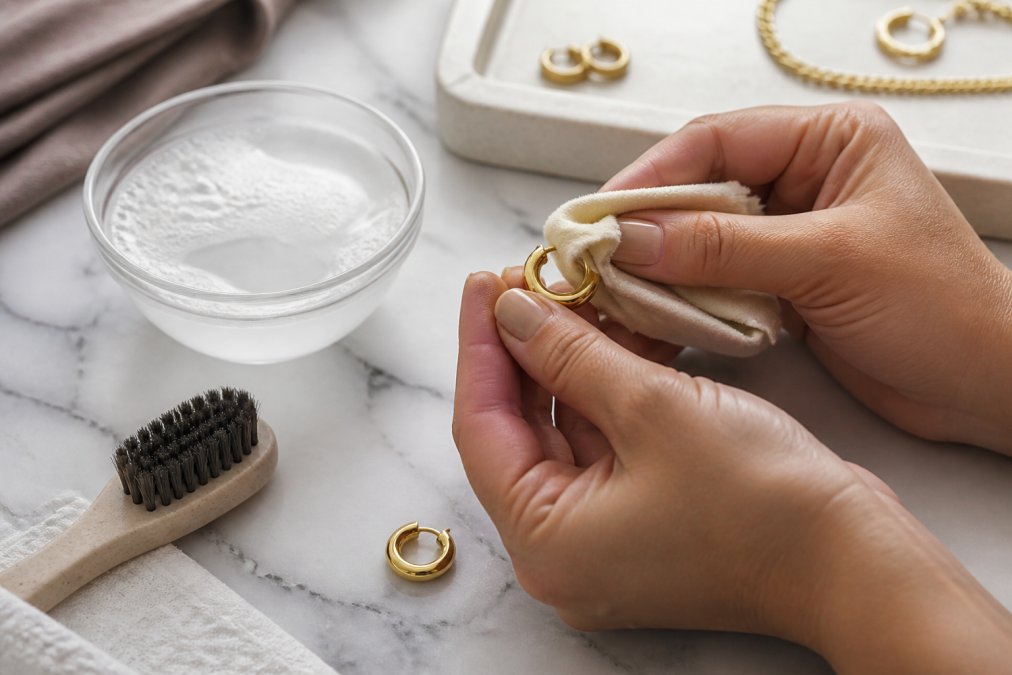
Clean plated pieces every few weeks if you wear them daily, and always after heavy sweating or sunscreen. Polishing cloths designed for gold are fine for a quick shine between washes. Never scrub a tarnished spot with an abrasive pad; you'll remove the gold before the discoloration.
Skin Sensitivity, Repairs, and Storage: What Most Guides Skip
Most guides stop at cleaning. These three topics decide whether a piece survives its second year.
Skin sensitivity and allergic reactions
Green or black marks on skin usually come from the base metal reacting with your sweat, not the gold itself. That discoloration is cosmetic, the metal salts are harmless and wash off. A true allergy is different: itching, redness, small bumps, or a rash that appears within hours to a day of contact and persists after the jewelry is removed.
Nickel is the most common trigger for allergic contact dermatitis, and one of the most common alloying metals in inexpensive jewelry because it's hard, cheap, and takes a bright polish. If you've reacted before, the base metal specification matters.
What to look for instead:
- Sterling silver base. A "925" stamp confirms it. Sterling silver is generally well tolerated, though a small number of people are sensitive to the copper alloyed into it.
- Nickel-free brass. Many quality makers now specify nickel-free brass, which avoids the most common trigger while keeping the price accessible.
- Titanium or surgical stainless steel posts. For earrings specifically, the post is the part in prolonged contact with the piercing, so a nickel-free post matters more than the visible plating.
- A barrier. If you love a piece but react to it, a thin coat of clear jewelry lacquer on the skin-facing surface can block contact. It wears off and needs reapplication, but it's a workable stopgap.
Gold plated pieces are not automatically hypoallergenic. The gold layer is thin and porous, and once it wears at a contact point, the base metal is exposed directly to skin. If sensitivity is your concern, buy for the base metal first.
Repair and re-plating
Plating wears through at high-contact points, and it can be restored. A jeweler can strip the remaining gold, polish the base, and electroplate a fresh layer. The economics depend on what's underneath:
- Worth re-plating: solid sterling silver, solid brass, or gold filled pieces with good construction. The base metal is stable, so the new plating has something sound to bond to.
- Usually not worth re-plating: hollow, stamped, or mystery-alloy pieces. The base is already corroding, the labor can exceed the piece's value, and the new plating fails the same way.
Before you buy, ask the maker what's the base metal?
Storage for longevity
Tarnish and oxidation are driven by air, moisture, and sulfur compounds. Storage is about starving those reactions of what they need:
- Separate every piece. Store each in its own soft pouch or lined compartment. Pieces jumbled together abrade each other's plating at contact points, the same wear mechanism that fades a ring shank.
- Use anti-tarnish protection.
- Control humidity. A dry drawer or a jewelry box with a silica gel packet beats a humid bathroom counter (jewelers.org). Moisture accelerates both corrosion and tarnish.
- Limit air exposure for pieces you rarely wear. A zip-top bag with the air pressed out, or a vacuum-sealed pouch for long-term storage, dramatically slows oxidation compared to an open dish.
- Choose the right box material. Lined jewelry boxes with a tarnish-resistant fabric (often marketed as anti-tarnish) outperform unlined wood or cardboard, which can off-gas compounds that speed tarnish.
Frequently Asked Questions
Is it worth it to buy gold plated jewelry?
Yes, if you understand what you're buying. Gold plated jewelry gives you the look of gold at a fraction of the cost, which makes it a practical choice for everyday wear and trendy designs. The key is buying from brands that use quality base metals like sterling silver or brass and apply a thick, even gold layer. Well-made pieces can stay beautiful for years with basic care.
How long does gold plated jewelry usually last?
It depends on plating thickness and how you wear it. A thin flash plating can wear off in a few months with daily wear, while a thicker plating over sterling silver or brass can last one to three years or longer. Pieces worn occasionally, kept dry, and stored properly often outlast those exposed to sweat, perfume, and water every day.
What is the difference between gold plated, gold vermeil, and gold filled?
Gold plated jewelry has a thin gold layer over a base metal like brass or copper. Gold vermeil uses a sterling silver base with a thicker gold layer, making it more durable. Gold filled jewelry bonds a thicker layer of gold to a base metal using heat and pressure. Each type has a different price point and lifespan.
Does gold plated jewelry tarnish easily?
It can tarnish over time, especially if the base metal is brass or copper and the gold layer is thin. Tarnish happens when the metal reacts with air, moisture, and chemicals in sweat, lotions, and perfume. Choosing pieces with a protective coating, keeping them dry, and wiping them after each wear slows tarnish significantly. Sterling silver bases resist tarnish better than brass.
How can you tell if gold plated jewelry is high quality?
Look for a stamped hallmark like 18k or 14k indicating the gold layer's purity, and check the base metal. Sterling silver or brass bases hold up better than cheap alloys. Thicker plating, often measured in microns, lasts longer. A smooth, even finish with no visible flaking or discoloration at edges is a good sign. Reputable sellers list these details openly.
What are the disadvantages of gold plated jewelry?
The gold layer can wear off over time, especially with daily wear, exposing the base metal underneath. It may tarnish or discolor if exposed to moisture, sweat, or chemicals. People with metal sensitivities can react to the base metal if it contains nickel. Gold plated pieces also can't be resized or repaired the way solid gold can.


