
Table of Contents
- The Real Cost of Handmade vs Mass-Produced Jewelry
- The Benefits of Handmade Jewelry That Actually Last
- How to Identify Quality Sterling Silver Jewelry
- Evil Eye Jewelry Meaning and Symbolism: More Than a Trend
- How to Spot Authentic Mediterranean-Inspired Designs
- Maintenance, Care, and Resale: Protecting Your Investment
- Verdict: Is Handmade Mediterranean Jewelry Worth the Price?
- Frequently Asked Questions
Last Updated: September 16, 2026
The Real Cost of Handmade vs Mass-Produced Jewelry
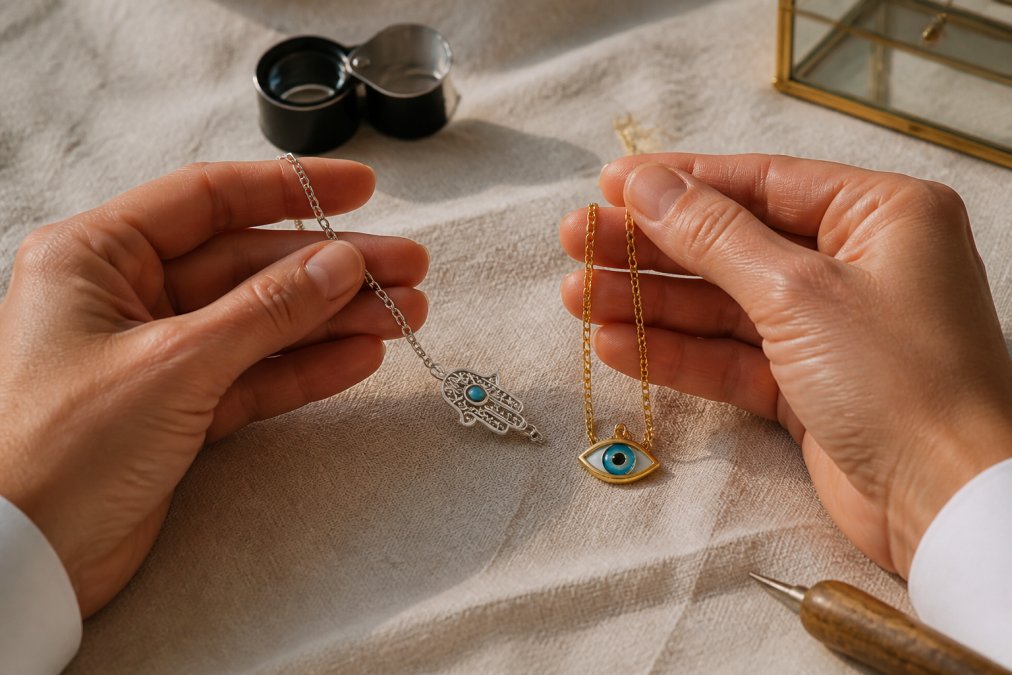
Handmade Mediterranean jewelry costs more because you are paying for skilled labor, precious metals, and small-batch production rather than machine time and composite materials. That premium is the entire question behind whether handmade Mediterranean jewelry is worth the price, and the answer depends on what you expect the piece to do after you buy it. At Gemma Azzurro, we sell sterling silver and gold-plated hamsa and evil eye designs, so we have an obvious stake in this argument.
| Factor | Handmade / Small-Batch | Mass-Produced |
|---|---|---|
| Base material | Sterling silver, 18k gold plating | Base metal, composite materials |
| Assembly | Hand-finished, soldered | Stamped, glued, machine-set |
| Finish | Hand-poured or hand-polished | Electroplated, thin coating |
| Consistency | Slight variation piece to piece | Identical units |
| Repairability | Often serviceable | Usually disposable |
The Benefits of Handmade Jewelry That Actually Last
The strongest benefits of handmade jewelry are durability and material quality, not romance. A hand-finished piece in sterling silver resists tarnish far better than a plated base-metal equivalent, because the silver is the metal, not a coating over something cheaper.
- Material quality: solid sterling silver instead of a plated core
- Tarnish resistance: real metal surfaces rather than thin coatings
- Repairability: clasps and links can often be replaced
- Weight: handmade pieces usually carry more silver per inch
How to Identify Quality Sterling Silver Jewelry
Learning how to identify quality sterling silver jewelry comes down to three checks: the hallmark, the weight, and the finish. None of them requires special equipment.
Hallmarks, Weight, and Finish: What to Check
- Hallmark: look for a "925" stamp, the standard mark for sterling silver (Buying Platinum, Gold, and Silver Jewelry). Its absence is your first warning sign.
- Weight: sterling silver feels denser than plated brass of the same size. If a chunky piece feels light, suspect a hollow or base-metal core.
- Finish: run a fingertip along the edges. Hand-finished pieces feel smooth; stamped pieces often have a sharp seam or a rough join where the plating is thinnest.
- Clasp and jump rings: on a bracelet, these take the most stress. A soldered ring outlasts a split ring every time.
- Magnet test: sterling silver is not magnetic. A magnet that grabs the piece means steel or nickel underneath.
Evil Eye Jewelry Meaning and Symbolism: More Than a Trend
Evil eye jewelry meaning and symbolism trace back to a simple idea: a glance of envy or ill intent is deflected by an eye that looks back. The hamsa, an open hand with an eye in the palm, carries a related protective meaning across Mediterranean and Middle Eastern cultures. Both are cultural heritage objects first and fashion second.
How to Spot Authentic Mediterranean-Inspired Designs
Authenticity in Mediterranean-inspired jewelry is about construction details, not a certificate. The styles most often imitated are filigree, granulation, and hand-set stone work, and each leaves physical evidence that a casting or stamping process cannot fake. Use this as a visual identification guide the next time you are holding a piece in person or studying a seller's close-up photos.
Filigree: Look for Open Space and Solder Points
True filigree is built from thin drawn wire that is bent, arranged, and soldered at contact points. That process leaves three tells:
- See-through gaps. Real filigree has open space between the wires. Cast imitations fill those gaps with solid metal because the mold cannot hold a void.
- Visible solder joints. Look at where wires meet. Hand-soldered filigree shows a tiny, slightly matte joint. Cast pieces show a smooth, uniform intersection with no joint at all.
- Wire consistency with variation. Hand-drawn wire varies by fractions of a millimeter. Machine-extruded wire is identical along its whole length, which reads as suspiciously perfect.
Granulation: Check Whether the Beads Are Fused or Glued
Granulation is the technique of fusing tiny metal beads to a surface, a hallmark of Mediterranean and Middle Eastern metalwork for centuries. On a genuine piece, the beads sit in slight depressions where they were fused to the base. On a replica, the beads are often glued or cast as part of the surface, so they sit proud with a visible gap or a shadow line underneath.
Stone Setting: Flush vs. Proud
Hand-set stones sit flush with or slightly below the metal surface, held by burnished edges. Glued stones sit above the surface and shift if you press them gently with a fingertip. On a hand-set piece, the metal around the stone shows small tool marks from the setting process. On a cast piece, the 'setting' is part of the mold and looks uniform across every unit.
Enamel: Depth vs. Flat Color
Hand-poured enamel has depth, slight color variation, and a surface that catches light unevenly. Printed or epoxy color sits flat, looks uniform across the piece, and often has a hard, plastic-like edge where it meets the metal.
The Reverse Side Test
Flip the piece over. The back is where factories stop working. A handmade piece is finished on the reverse, with the same care as the front. A stamped or cast product often has a flat, raw, or hollowed back that does not match the front's level of detail.
A Quick Checklist
- Balanced weight distribution so the piece hangs straight
Maintenance, Care, and Resale: Protecting Your Investment
Jewelry maintenance is what separates a piece you wear for two years from one you wear for fifteen. Sterling silver and gold-plated jewelry both tolerate daily wear well if you understand what actually degrades them and follow a few habits.
What Actually Causes Damage
Two mechanisms do most of the harm:
Sterling silver blue opal hamsa bracelet →
- Tarnish on sterling silver is a chemical reaction between the silver and sulfur compounds in air, sweat, and some cosmetics. It is a surface film, not corrosion, which is why it can be polished away. The 925 alloy contains copper, and it is the copper that reacts first.
- Plating wear on gold-plated pieces is mechanical, not chemical. The gold layer is measured in microns, and it thins fastest at friction points: the clasp, the jump rings, the underside of a pendant, and anywhere the piece rubs against skin or other jewelry.
Understanding which mechanism applies to your piece tells you what to protect it from. Sterling silver needs protection from sulfur and moisture. Gold plating needs protection from abrasion.
A Care Routine That Works
- Put jewelry on last, after perfume, lotion, and hair products have dried. Alcohol and oils in cosmetics accelerate tarnish and can dull plating.
- Take bracelets and necklaces off before swimming, showering, or working out. Chlorine and salt water are hard on both silver and plating.
- Wipe with a soft dry cloth after wearing to remove skin oils and residue before they set.
- Store pieces separately in a dry pouch or a lined box. Sterling silver stored touching other silver tarnishes faster at contact points.
- Use a silver polishing cloth for sterling silver. Avoid abrasive dips and ultrasonic cleaners on plated pieces, because both can strip thin plating.
- For plated pieces, a soft dry cloth is the only safe routine. Do not polish plated jewelry with silver polish.
Cost-Per-Wear: The Math That Matters
Resale value is the wrong frame for most handmade Mediterranean jewelry. Precious metals hold some scrap value, but you should not expect appreciation. The real return is cost-per-wear.
When Resale Does Make Sense
A few situations where resale value is worth considering:
- Solid precious metal pieces hold scrap value tied to the metal price, which fluctuates but rarely goes to zero.
For deeper guidance on how silver and plating behave over time, our sterling silver care guidance from the Gemological Institute of America is a useful reference.
Verdict: Is Handmade Mediterranean Jewelry Worth the Price?
Yes, for most buyers, if you plan to wear the piece regularly. Handmade Mediterranean jewelry is worth the price when the materials are honest, the construction is hand-finished, and you will wear it more than a few times a year. It is not worth the premium if you want a one-season accent piece or need dozens of identical units.
The deciding factors, in order of weight:
- Metal content. Sterling silver and real gold plating outlast base metal every time.
- Construction. Soldered joins and hand-set stones survive daily wear.
- Frequency of wear. The more you wear it, the lower your cost-per-wear.
- Symbolism. If the evil eye or hamsa meaning matters to you, a considered design is worth more than a trend piece.
Frequently Asked Questions
Is handmade silver jewelry more durable than mass-produced alternatives?
Handmade sterling silver jewelry often lasts longer because it uses solid 925 silver rather than plated base metals that can flake over time. The difference shows up in the weight and how the clasp holds up after months of daily wear. A piece with proper hallmarks and a solid clasp can offer better value over time, which changes the real cost-per-wear math.
How can you tell if handmade Mediterranean jewelry is high quality?
Look for a 925 stamp on sterling silver pieces, check that clasps and jump rings feel solid, and inspect the finish for rough edges. Pieces can show small variations. Ask about the metal content and how the piece was made. A brand that answers those questions clearly, and backs the piece with a money-back guarantee, is usually the one worth buying from.
Why does Mediterranean jewelry often feature evil eye and hamsa designs?
The evil eye and hamsa are protective symbols with roots across Mediterranean and Middle Eastern cultures, worn for centuries to ward off misfortune and bring good luck. The evil eye meaning centers on deflecting envy, while the hamsa represents protection and blessing. Modern designers translate these symbols into everyday pieces like bracelets and necklaces, so you can wear the cultural heritage without it feeling like a costume. That layered meaning is part of what separates artisan Mediterranean jewelry from a plain fashion accessory.
How do you care for gold-plated Mediterranean jewelry to ensure longevity?
Keep gold-plated pieces away from perfume, lotion, and chlorine, and put them on last when getting ready. Wipe them with a soft dry cloth after wearing to remove oils, and store them in a pouch or box rather than loose in a drawer. Remove bracelets and necklaces before showering, swimming, or working out. With that routine, 18k gold plating over sterling silver holds its color far longer than plating over brass, which is why the base metal matters as much as the finish.
Is it worth paying more for artisan-crafted jewelry instead of a cheaper lookalike?
It depends on how often you wear it. A $39 sterling silver bracelet worn daily for two years costs pennies per wear, while a $15 plated piece that tarnishes in two months costs more each time you replace it. If you want one piece you reach for constantly rather than a drawer of throwaways, the higher upfront price usually wins.


