
Table of Contents
- Step 1: Understand the Meaning of Hamsa Hand Direction Before You Buy
- Step 2: Match the Hamsa Hand Necklace to the Recipient's Personality
- Step 3: Choose Your Metal with Confidence: Gold Plated vs Sterling Silver Jewelry for Gifts
- Step 4: Know What Tarnish Free Evil Eye Jewelry Actually Means
- Step 5: Verify Authenticity and Quality Before You Commit
- Step 6: Plan for Care and Maintenance from Day One
- Common Mistakes to Avoid When Gifting a Hamsa Hand Necklace
- Frequently Asked Questions
Last Updated: September 16, 2026
Step 1: Understand the Meaning of Hamsa Hand Direction Before You Buy
The fastest way to choose a hamsa hand necklace for gifts is to start with the symbol itself, because direction changes what the piece communicates. The hamsa is a palm-shaped protective amulet worn across the Mediterranean and Middle East, appearing in both Jewish and Islamic traditions. In Islamic culture it is often called the Hand of Fatima; in Jewish tradition it is tied to the Hand of God.
Fingers Up vs. Fingers Down: What the Direction Means
Fingers up is the most common orientation, generally read as warding off the evil eye with the palm facing outward to deflect negative energy. Fingers down is a newer styling choice, treated as a way to invite good fortune inward or balance a layered neckline. There is no single authoritative rule here.
Step 2: Match the Hamsa Hand Necklace to the Recipient's Personality
Personality matching separates a gift she wears weekly from one that stays in the drawer. A hamsa hand necklace works for almost anyone, but the styling has to fit how she already dresses. The framework below turns vague "minimalist or statement" advice into four recipient profiles you can shop against.
The Four Recipient Profiles
The Everyday Minimalist. She wears one necklace and never swaps it. Look for a pendant under 0.5 inches, a 16-18 inch chain, and a single small stone or none. A dainty hamsa in solid sterling silver is safest because it survives constant wear without a plating to flake.

How to Read Her Existing Jewelry in Under a Minute
You do not need to ask her directly. Look at what she wears on a normal Tuesday:
- Chain length: Under 16 inches is a choker; 16-18 inches is the collarbone; 20-24 inches is a drop. Match or go one step longer, never shorter.
- Metal tone: If her watch, rings, and earrings are all one tone, match it. If she mixes, you have freedom.
- Pendant scale: Smaller than a dime signals minimalist; larger than a quarter signals statement.
- Finish: Matching the finish she already owns makes the new piece feel intentional rather than random.
A Quick Matching Shortcut
If you only remember one thing: match the piece to the jewelry she already reaches for, not to the outfit you imagine her wearing. When in doubt, choose the smaller, simpler option, because a dainty hamsa layers into almost any style while an oversized one only works for one profile.
Step 3: Choose Your Metal with Confidence: Gold Plated vs Sterling Silver Jewelry for Gifts
The metal choice comes down to two questions: does the recipient have sensitive skin, and how does she wear her jewelry day to day. Sterling silver is a solid 92.5% silver alloy, consistent all the way through. Gold plated jewelry uses a sterling silver base with a layer of gold bonded to the surface, giving the warm tone of gold at a lower price than solid gold.

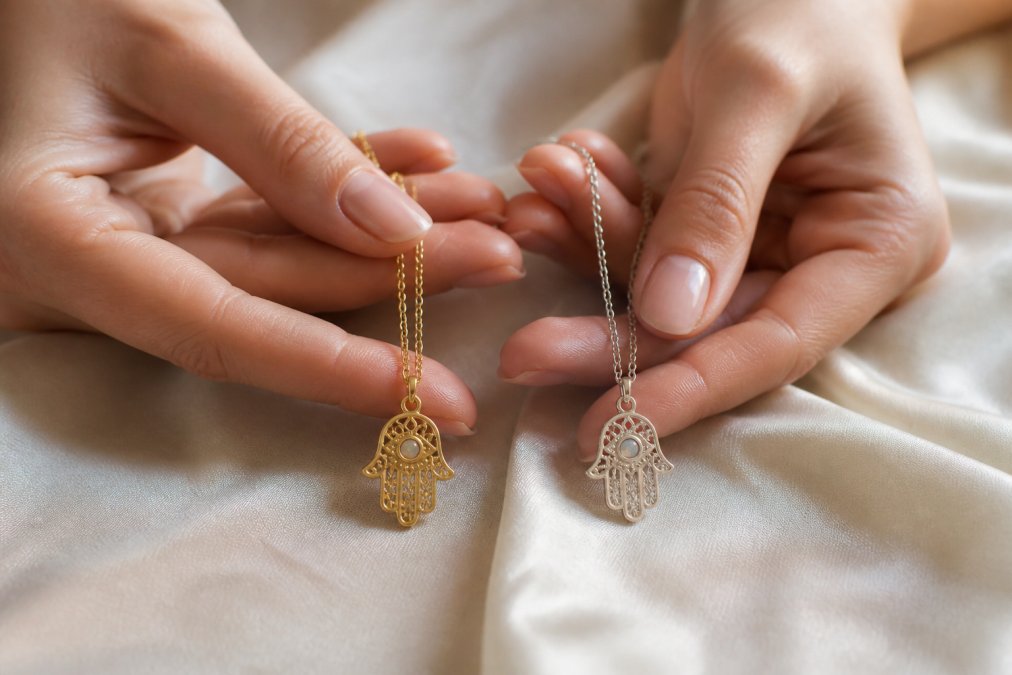
| Feature | Sterling Silver | Gold Plated (18k over sterling) |
|---|---|---|
| Base metal | 92.5% silver, solid throughout | Sterling silver core |
| Color | Cool, bright white tone | Warm gold tone |
| Best for | Everyday wear, sensitive skin | Warm undertones, dressier looks |
| Care needs | Polish to remove tarnish | Gentle wipe, avoid abrasives |
Skin Sensitivity and Metal Allergies
Metal allergies are usually a reaction to nickel, not to silver or gold themselves, so the base metal matters more than the color. A sterling silver or gold plated piece over a sterling base avoids the nickel-heavy alloys in cheaper costume jewelry, often the cause of the green or black marks people describe. If the recipient has reacted before, ask what the piece was made of; the answer is usually "costume" or "unknown."
Step 4: Know What Tarnish Free Evil Eye Jewelry Actually Means
"Tarnish free" is a marketing phrase, not a material specification. Tarnish is surface discoloration that forms when silver reacts with sulfur compounds in air, sweat, and cosmetics. Sterling silver can tarnish; the question is how quickly and how easily it cleans up.
Step 5: Verify Authenticity and Quality Before You Commit
Authenticity verification takes about two minutes and saves a return. A checklist tells you what to look for but not how to judge what you find, and mass-produced costume jewelry can pass a shallow checklist while failing in the details that matter six months later. Here is how to verify craftsmanship, not just spot a stamp.
Start With the Hallmark and the Material Breakdown
Genuine sterling silver is stamped 925, usually on the clasp, the pendant back, or a small tag near the clasp. Reputable gold plated pieces state the plating karat, such as 18k gold plating over sterling silver. If a listing claims sterling silver but shows no stamp and no material breakdown, treat that as a warning.
Sterling silver gold plated dainty →
How to Tell Real Craftsmanship From Costume Jewelry
Mass-produced pieces are made to hit a price point, and the shortcuts show up in predictable places:
- The clasp. A quality lobster clasp has smooth spring action and a solid body. A flimsy clasp feels loose, sticks, or has visible seams where the metal was folded rather than cast.
- The chain. A quality chain has uniform links with no kinks, soldered blobs, or stretched links. A cheap chain feels light for its size and tangles easily.
- The pendant edges. Real craftsmanship shows smooth, finished edges with no rough casting marks, pitting, or seam where two halves were joined. Costume pieces often have a hollow back or visible mold line.
- The stone setting. Prongs or bezel should sit tight with no gaps and no movement when you press gently. A loose stone is the first thing to fall out.
- The weight. A solid sterling pendant has a heft that matches its size. A piece that feels surprisingly light is often hollow or plated over base metal.
The Two-Question Test for Any Listing
Before you buy, ask the seller two questions:
- What is the base metal? The answer should be specific: "925 sterling silver" or "sterling silver with 18k gold plating." Vague answers like "silver tone" or "gold color" describe appearance, not material.
- What is the return window and what does it cover? A 14-day money-back guarantee is a reasonable minimum for online jewelry, giving the recipient time to try the piece on with real outfits. A guarantee covers the purchase, not wear and tear months later.
Why This Matters More for a Gift
When you buy jewelry for yourself, a disappointing piece is a minor annoyance. As a gift, a piece that discolors in two months undercuts the meaning of the gift entirely. The recipient may not say anything, but she will notice. Two extra minutes on verification protects both the piece and the gesture.
A Note on "Authenticity" for a Symbol
The hamsa is a cultural and religious symbol, not a branded product, so authenticity here means craftsmanship and honest materials, not a certificate of origin. No single authority certifies hamsa necklaces. What you can verify is the metal, the construction, and the seller's willingness to stand behind the piece.
Step 6: Plan for Care and Maintenance from Day One
Care decides whether a hamsa hand necklace still looks new in a year. The biggest cause of premature wear is chemical exposure, not daily use. Perfume, hairspray, sunscreen, and chlorine attack both silver and plating, showing up as dullness or flaking.
Build these habits into the gift:
- Put jewelry on last, after perfume and lotion have dried.
- Take it off before showering, swimming, or working out.
- Wipe it with a soft dry cloth after wearing to remove oils.
- Store it in a pouch or box, not loose in a drawer where chains scratch.
- For sterling silver, use a polishing cloth when it dulls. For gold plated pieces, skip abrasive polishes, which strip the plating.
Common Mistakes to Avoid When Gifting a Hamsa Hand Necklace
The mistakes that ruin a jewelry gift are predictable, and most happen before checkout. Buying for the giver's taste instead of the recipient's is most common: a bold pendant for a minimalist, or a tiny charm for someone who wants a statement. Match the piece to her existing style, not the product photo.
Frequently Asked Questions
Should a hamsa hand necklace face up or down?
Both directions carry meaning. Fingers facing up are believed to ward off negativity and invite good fortune, while fingers facing down are thought to draw blessings and abundance toward the wearer. Neither is wrong. When choosing a hamsa hand necklace as a gift, pick the direction that matches what you want the piece to represent for the recipient. If she simply loves the design, any direction works beautifully.
What is the difference between an evil eye and a hamsa symbol?
The evil eye, or nazar, is a circular blue eye symbol meant to deflect jealousy and harmful glances. The hamsa is a hand-shaped amulet, also called the Hand of Fatima, that represents protection, strength, and blessings across multiple cultures. Many pieces combine both symbols. If you want a gift focused purely on protection, either works. If you want layered cultural heritage in one pendant, look for a design that pairs the hamsa hand with an evil eye accent.
How do I choose between gold plated and sterling silver for a gift necklace?
Gold plated over sterling silver gives you the warm look of gold with a durable silver base, which suits most recipients and everyday wear. Sterling silver on its own offers a cooler, more understated look and works well for someone who prefers minimalist jewelry. For sensitive skin, sterling silver and 18k gold plated pieces are both safer choices than base-metal alloys. Match the metal to what she already wears most often.
How can I tell if a hamsa hand necklace is well made before gifting it?
Check the metal content first. Look for 925 sterling silver or clear 18k gold plating details in the listing. Examine the jewelry finish for smooth edges and secure stone settings. Read reviews from buyers who wear the piece daily, especially about tarnishing or wear over time. A brand that offers a money-back guarantee and states its materials clearly, like Gemma Azzurro, gives you a safer starting point than a listing with vague descriptions.


